Pursuance, or I Don’t Quite Get de Man
 Jeff Allred (he/him/his) on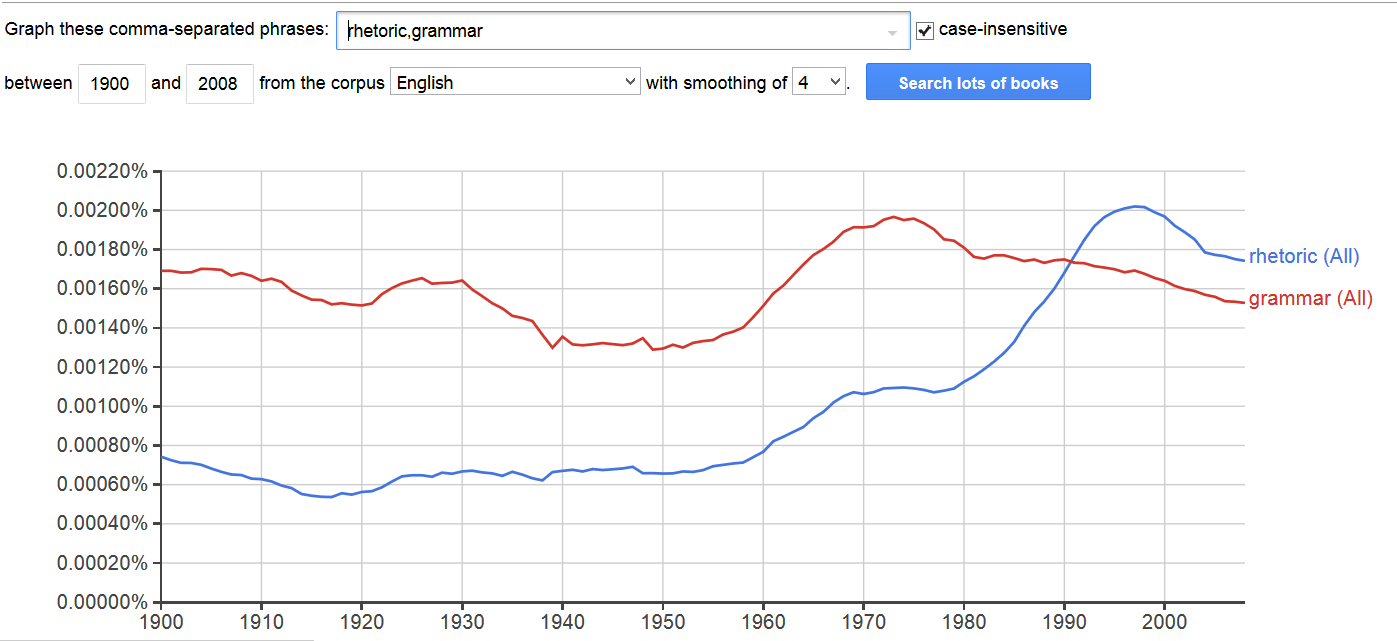
Continuing in a line of thinkers pursuing an understanding of how exactly language does, de Man maintains a Structuralist’s careful eye to inner cleavages—reading from “an inch over the text” (1362) and accepting the idea that Text is, to start, some internally working whole. Like his related ideological predecessors Nietzsche and Saussure, Paul de Man shows curiosity about peering under the skin of seemingly autarchical words, interdependent (but destabilized?) atoms that create vivid pieces of literary text. Noting “a highly respectable moral imperative that strives to reconcile the internal, formal, private structures of literary language with their external, referential, and public effects”, he nods to a concern akin to semiologist and linguist Roman Jakobson’s, who took a close eye to the difference between the associative function (the way that in metaphor, one associated word is replaced for another, for de Man called “paradigmatic) and the syntagmatic (the means by which words relate horizontally and temporally, and constitute metonymic meaning).
Admittedly, the challenge seems a sprawling one, and I am often left following de Man’s argument with focused eyes that fail to see through murky waters.
Paul de Man writes on 1368 of how “one of the most striking characteristics of literary semiology […] is the use of grammatical (especially syntactical) structures conjointly with rhetorical structures without apparent awareness of a discrepancy between them.” By rhetoric, he claims to here be speaking of “the study of tropes and figures”—specific way words interrelate to create certain modes of meaning. His issue with writers like Ducrot and Todorov is that they have traditionally treated this rhetoric more as merely a paradigmatic view of words without strong question of they work when contiguous. Heralding one of Jakobson’s concerns at the conclusion of Metaphor and Metonomy, de Man treats a passage of Proust’s Swann’s Way to uncover that there is an abundance of figurative language in which both these modes of language are used in a conjoined fashion, leading to an almost exasperated conclusion: Why has the combination of both been only treated descriptively and nondialectically without considering the possibility of logical tensions?
At this point in his argument, de Man finds a moment to pit stop at the ideas of J. L. Austin regarding the performativity of language: the notion that language is more than descriptive of the world (which has relevance with the map semioticians think about words mapping onto real underlying things), but that enunciating language—utterance, if you will—constitutes an action in itself. Austin postulated the tripartite division of speech acts as locutionary (saying something meaningful), illocutionary (saying something meaningful for some purpose), and perlocutionary (having an effect on those who hear what is said).
In this step of the work, we are juggling a variety of perspectives, this most recent one transcending purely literary concerns and acutely aware of language as taking part in action. Attempting to elucidate his definition of rhetoric, he sets up a semi-helpful dichotomy: grammar, concerning internal relationships between sound, syntax and meaning, is somewhat akin to the illocutionary act; rhetoric, traditionally exclusively a way we describe the perlocutionary way of persuasion, is created only by dint of grammatical function, and so thus “the continuity [between the two] is self-evident”. Admittedly, this is somewhat less so for me, still unsure of what he means by rhetoric, and if I have all the meanings straight: our traditional way of speaking about persuasive oratory, but also another way of describing the poetic ability of language—how indeterminacy of language, which he refers to on the next page with a discussion of Pierce and the infinite deferral of the signified, creates an excess of infinitely refractive meaning. But de Man’s endgame here is to craft the “basis for a new rhetoric that […] would also be a new grammar” (1369).
I’m tempted to give up at this very early point in the text with a formal declaration of defeat. The kind of stability I am looking for in terminology seems nowhere to be found in the work etiquette of the deconstructionist de Man. And more so, the whole point of creating instability seems to run counter to any act of elucidation looking for an easy point A to B to C, in the way I have been proceeding here.
As a kind of white flag, I want to tie back, with his oppositional arrangement of “rhetorization of grammar”, the way in which poetic meaning makes interpretation along grammatical lines impossible. To complement this, de Man touches on the “grammatization of rhetoric”, using his account of Proust to show that figural language can run along the lines of “semi-automatic grammatical patterns”, initially deceiving us into a certain mode of analysis that de Man contests that validity of. In conclusion: the reader is left with nil: there is no safety, no useful guidelines, “the same state of suspended ignorance”. The illusory prize of an indeterminably nebulous language seems like barely any prize at all.