Monthly Archives

15 Articles

Uncategorized

Question on Freud

Posted by Jeff Allred (he/him/his) on

The psychologist is in:

A student asked an excellent question via email that I’ll share, anonymously. Here goes:

I was hoping you can help me in understanding Freud’s text related to dreams. What is the difference between the latent content (which is “dream-thoughts”?) and the manifest content? And how does condensation and displacement factor in with the two?

Great question. Freud’s breakthrough is to conceptualize the psyche as a dynamic entity in which energy flows through different areas or states and is processed along the way via “censorship.” So the “dream-thoughts” or “latent content” (and yes, these are synonyms) are the products of the “id” that are inaccessible to language and hence to thought. Manifest content is what remains when you wake up: the jumble of images or fragments of narrative that you jot down, if you’re a good patient!

What Freud calls the “dream work” involves basically decompressing this “manifest content” and making it meaningful via a process of decoding. “Condensation” and “displacement,” then, are fundamental features of the “code” of dreams: the former names the tendency of manifest content to be “laconic,” such that each image is saturated with meaning; the latter names the tendency of manifest content to substitute something of low value for something of high value. As in my example in class of a dream in which I was ironing shirts and scorched the shirts, the mundane process of ironing might speak to extreme anxieties about my self-presentation in public, status as a “white-collar” worker, and so on: stuff that is charged with intensity for me.

Keep ’em coming, folks: I’ll be here all day.

Uncategorized

The Black, White, and Gray

Posted by Jeff Allred (he/him/his) on

Sedgwick defines and picks apart the many holes and well known knowledge of the words sex, gender and sexuality. Sex, or “chromosomal sex” as she likes to refer to it as, refers to the more scientific term and associations with the word ‘sex’. Meaning the actual chromosomal and physical attributes of the human body and it’s make up. Gender is a more societal construction to Sedgwick, seeing as the many ways we identify a girl or boy is by appearances and behaviors that we take in and process under our own well known and groomed in ideas of what a man or woman is or would be. Sexuality would be the actions and expectations of each gender that coincide with their gender in a sexual way.

With these definitions set in place by Sedgwick, she then poses the question of whether or not feminism is a gender or sexuality problem. She goes on to say that gender and sexuality are one in the same, both laced within each other and therefore stand hand in hand. I agree with this idea because of how mixed and how stretched every form of the words sex, gender and sexuality can become.

In these current times, sex, gender and sexuality can be bent in many different ways to accommodate different perspectives. Many people believe a definite term for these words can be met but this to me seems too concrete for these words that could have so many different meanings. Sexuality, gender and sex have so many different ideas, spaces and definitions. Gender and sexuality an idea of the self that a person finds for themselves. It cannot be pigeonholed into one specific field or definition. While this may be the same type of argument that many people have heard, in 2015 it’s ridiculous to think that a person could try to grasp the idea of gender or sexuality into a single sentence. Gender and sexuality shouldn’t be a social construct, but a personal individual experience for every person.

I think that the individual should be able to define themselves, or not define themselves at all. A lot of prejudices seem to stem from ignorance, or the reaction of people going or being outside of someone else’s range of ‘normalcy’ or what they know. This type of ignorance or discrimination is used against transgendered individuals and homosexuals (as well as countless other ‘groups’). The problem stems from people’s inability to understand gender or sex outside of the actual ‘physical’ or anatomical make up of an individual at the present time or at birth. As well as many masculine females or feminine males are ‘picked on’ by others.

Then comes the issues of feminism. Not the movement or point of feminism itself, but the backlash or understanding of feminism. Sedgwick bridges the issues of racism and classism to feminism, saying that these oppressions are all similar in a more complex way because even though they are all different, they are all processed in a similar way. Sedgwick explains how any versions or references to sex are oppressed or picked apart by society. This comes from a feeling of discomfort, which I believe stems from the ‘taboo’ or negativity that seems to wind itself around any word, idea or feeling that is sexually charged.

Going back to the beginning of history, sex was a primal instinct, and gender was meant to decide who would procreate and pass on a bloodline. As societies grew and became civilized, they became more ‘modest’. The human body was scandalous, and sex was expected but never spoken about. Even more so, sexual acts were forbidden and never spoken about. These negative connotations to sexuality, sex and gender were conceived way before feminism was ever given a name. More so, women were always shed in a bad light, expected to be pretty, not ugly, seen, but not heard. Feminism acts or qualities were given a weaker connotation, a sad truth that still holds (mostly) true today.

Thus, feminism and feminist movements are misconstrued and receive a negative backlash because of centuries of outdated, ridiculous and what should be dead ideas and connotations. Sedgwick’s piece not only investigates these ideas, but also attempts to define sex, sexuality and gender, whereas I personally believe those three terms are too loosely used and perceived to fully grasp.

Uncategorized

Can Women and Homosexuals have Fetishes too?

Posted by Jeff Allred (he/him/his) on

When one thinks of fetishism, without researching or looking into the science of the concept, it is most probably simply an object, body part, or even an action that sparks an emotion of sexual release. The fetish object is often not one that we have chosen ourselves and can be one that is not easily obtained and so through a building of sexual tension, the release of this desire is the ultimate realization of what the fetish is. Today, the idea of a fetish is normative and differs from person to person. To me, a fetish can only be realized through the range of experiences, such that the one fills a void is the one we come to acknowledge as our fetish.

Psychoanalyst, Sigmund Freud, argued many theories about the development of the human sexuality explained at an unconscious level, which is troubling enough because there is no definitive way to measure the unconscious or the pathway through which the unconscious thought becomes a conscious action. The reading “Fetishism” was difficult to understand because of my inability to relate. Though his arguments deem sound because he observed or interviewed adult men, considering the imaginative nature his arguments, evidence for his track of thought is incomplete. I can agree that fetish stems from an event that affects the way we explore our sexuality, I cannot necessarily agree that it stems from the fear of castration because of its desirous nature. When Freud describes the initial experience of a young infant  boy that realizes his mother’s parts are unlike his, I am still uncertain as to how that leads to the substitution of a body part or inanimate object that then becomes a fetish. This is because the ranges of fetishes are infinite and often cannot be described as an object that reminds one of their childhood and more often than not, people have multiple fetishes. I therefore argue that a fetish is desirous because it provides an emotion or sexual tension that we seek and cannot get elsewhere. In order to discover a fetish or multiple fetishes, exploration (and not “investigation”) is required.

On page 843, Freud states, “Why some people become homosexual as a consequence of that impression, while others fend it off by creating a fetish, and the great majority surmount it, we are not able to explain.” The idea that homosexuality is not predetermined and is too a result of the castration complex was just as troubling because aside from desiring the same sex, homosexuals can too have separate fetishes. The distinction the path by which the infant determines or chooses between fetishism and homosexuality wasn’t well explained or proven, as much as it may have seemed like a sequential outcome.

Also, in Freud’s introduction of fetishism, it was difficult to understand from a woman’s perspective simply because we have the same parts as our mother’s and do not experience the same fear. Since his observations consisted of male subjects, the weakest point of his argument comes from the difficulty to empathize with the castration complex is irrelevant because women do not go through the same process of the initial experience in which Freud describes as the point of fetish introduction. Is it then abnormal for a woman to have fetishes? Knowing that women do have fetishes, I began to question whether we too undergo a process by which a fetish becomes the substitute or if there is a deeper understanding to fetishism that Freud could not describe.

Uncategorized

Propaganda

Posted by Jeff Allred (he/him/his) on

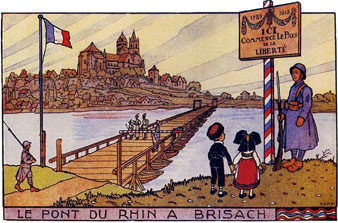
Lately, I’ve been looking at caricatures and sketches dating from the turn of the 20th century. They come from Alsace, which straddles the Rhine River, crammed between France and Germany. Since 1870, Alsace has been caught amid recurring wars between the two great nations of the time. Since 1870, Alsatians have switched nationalities five times, some willingly, others not so. I won’t begin to touch upon the burgeoning regionalism only nascent at the time of these caricatures for fear of writing a book. However, in light of their historical context and the explicit French sentiment they express, not to mention their publication and dissemination in France, these illustrations can be interpreted as propaganda. How is this helpful? Perceiving these illustrations as propaganda emphasizes their persuasive element that is dependent on their metaphorical construction. A Lacanian analysis will illustrate the intended effect upon the audience, in regards  to whom little French children were to meant to identify with.

Before Lacan can be of any use, a postcolonial interpretation of the Other will first edify how the Other is depicted through the use of stereotype. If we are to assume, as Homi Babha has posited, that national identities are transitional and indeterminate, then a definite relation between the subject and the Other is impossible. Yet, that is patently false in artistic representations. Therein, stereotypes crystallize difference so as to define the Other in relation to the subject. In doing so, the Other is inculcated into a discourse in which it is knowable and thus definable. Here, Lacan illumines that knowledge of the Other is, and can only be, defined by knowledge of the subject, and, by consequence, vice versa. Stereotypes thereby act not only as typification of the Other, but as typification of the subject. Idyllic representations thus invest propaganda with power through their extension of discourse to include the Other. A reader would then be able to identity with a representation through a negative identification with the Other.

Examples will illustrate the connection I have established between children’s literature, propaganda, stereotypes, and Lacan. All three images (included below) are illustrations from Jean-Jacques Waltz (a.k.a. Hansi) in his book L’histoire d’Alsace racontee aux petits enfants (The history of Alsace told to little children) which was very popular in France and received semi-state recognition. Three elements are immediately recognizable: Germans, Alsatian (depicted as children), and Frenchmen. This work was meant to associate the region with French national sentiment so the German is the Other. However, the German is depicted in two drastically alternative ways. Figure 1 presents a family of Germans barred from Alsace (note the French tricolor post) that appear emaciated. Indeed, the caption reads that they are as “skinny as nails”. Yet, figure 2 depicts a healthy German soldier who resembles the French soldier in figure 3. A reader must account for these stereotypes in relation to the subject. Figure 1 presents no Alsatian or Frenchmen with which to contrasts the sickly Germans; however, the post presents a barrier between the reader and the image. A French child is presented a distinction between him- or herself and the Germans on the other side of the tricolor post. Figure 2 should take into account the relation between the imperial soldier and the Alsatian children that are oppressed by his gaze (another discussion would include the boy’s snide glare).  Yet, a French child would not be able to identify with the Alsatian children in figure 2 were it not for figure 1 and the contrast of figure 3. This last representation is of a French soldier, facing the reader, and of Alsatian children facing the soldier. Whereas the children were meek under the German, they are proud with the French soldier. Indeed, the reader can only establish this relation because the children gaze up into the soldier who has a proud demeanor. Those Alsatian children thus perceive themselves in the reflection of the soldier’s gaze. Similarly, French children would identify nationally with the French soldier and, via him, the Alsatian children.

Figure 1

Figure 2

Figure 3

Uncategorized

Oedipus vs. Hamlet: Who’s more F*cked up?

Posted by Jeff Allred (he/him/his) on

In his book, The Interpretation of Dreams, psychoanalyst Sigmund Freud describes a psychological condition of one having romantic and sexual desire for the parent of the opposite sex, while hating the other parent, as the “Oedipus complex”. This term is coined from Freud’s analysis of Sophocles’ play, Oedipus Rex, in which the titular character (by force of prophecy) unknowingly murders his father and weds his mother, as well as fathering children with her. Freud compares how this factor in Oedipus Rex compares to how it plays out in William Shakespeare’s Hamlet.

The difference in the manifestation of the Oedipus complex in the two plays is rooted in the differences between the two respective main characters. Oedipus is a character who is defined by his actions; he is unaware of fulfilling both the prophecy and his subconscious urges, which ultimately drives the tragedy of the play. Freud states, “Oedipus Rex is what is known as a tragedy of destiny. Its tragic effect is said to lie in the contrast between the supreme will of the gods and the vain attempts of mankind to escape the evil that threatens them. The lesson which, it is said, the deeply moved spectator should learn from the tragedy is submission to the divine will and realization of his own impotence,” (815). It is by Oedipus’s own actions – driven by both destiny and ignorance – that causes his ultimate downfall. This is where I disagree with Freud’s concept that he derives from this play; his theory entails that humans have this innate and subconscious desire for murdering one parent and performing coitus on the other, yet when that element of the psyche enters the conscious, the title character rejects it and punishes himself for it. My hypothesis is that had Oedipus had the knowledge of the identities of his mother and father, he would not have fulfilled the “prophecy” that was set for him. Freud doesn’t give human beings enough credit for self-control, let alone using a fictional character from a play to prove his theory.

With that said, I feel that Hamlet’s contrast in its titular character from Oedipus Rex further proves my thesis of Freud’s weakness in his Oedipus complex theory. Whereas Oedipus’s character is marked by his actions, Hamlet prevents himself from fulfilling the same prophecy. Freud states, “Hamlet represents the type of man whose power of direct action is paralysed by an excessive development of his intellect…According to another view, the dramatist has tried to portray a pathologically irresolute character which might be classified as neurasthenic,” (817). It is due to Hamlet’s ponderous and indecisive nature that he fails to act on his supposed desire. While Oedipus Rex is built on its title character blindly acting towards fulfilling the prophecy, Hamlet is built on its title character’s hesitations over killing the man that has essentially filled the role of his father. But Freud insists that it is the “peculiar” nature of this act that prevents Hamlet from commiting it, “Hamlet is able to do anything – except take vengeance on the man who did away with his father and took that father’s place with his mother, the man who shows him the repressed wishes of his own childhood realized,” (817-18). Thus, Hamlet sees in his father’s killer what psychology would dictate him to commit. Hamlet sees reproach in this act, which supersedes his desire for revenge. By witnessing his “repressed wishes” fulfilled by another entity, Hamlet gains a level of conscience that Oedipus never possesses until after he realizes who he killed, and who he wed.

Uncategorized

Appearances and Love

Posted by Jeff Allred (he/him/his) on

Courtly love in the middle ages was what I would consider a crush today. The noble knight admired a woman, usually one who was married from afar and fantasized her. The woman is fantasized and the man has his own thoughts on what he thinks she is which is far from who she really is. As Slavoj Zizek says, “…how the Lady in courtly love has nothing to do with actual women, how she stands for the man’s narcissistic projection which involves the mortification of the flesh-and-blood woman…” Zizek shows here that courtly love has nothing to do with the actual woman and her feelings or morals. None of that. The man is pleasing himself with someone he’s imagined.

Courtly love reminds me very much of Lacan’s essay and the whole concept of the mirror image. Lacan’s concept of the mirror image is very relevant in today’s world and so is the whole courtly love idea. Courtly love is all about falling in love with an “image” and ideal image which as humans we do very much. Let’s think about all the women we admire on magazines and billboards. Their beauty is eye catching and it drives some to want that for themselves. The image in the mirror is very dangerous. We get caught up in it and we fantasize it. It drives us to being narcissistic and obsessive. We do the same when it comes to romanticizing relationships and marriage. Often times we look at other idea relationships and want that for ourselves too. This goes back to courtly love. In courtly love, the knight admires and romanticizes a love he doesn’t have and wants but can’t. We romanticize the ideal, admiring it for what seems perfect.

Zizek also makes a great point on page 2419 saying, “…he has attained what he really wanted: not the act itself, just her consent to it.” This goes back to the whole courtly love concept where the person fantasizes and has a greater love because he can’t have it but once he does, it’s not as expected. Why? Because the woman isn’t necessarily as similar as the man’s fantasies. Instead she is an actual human. I think this is what also annoys me when it comes to fantasizing women and romanticizing them in the media. They’re shown ideal and very unrealistic. This is also the same for the mirror image. The image we look up to is unrealistic, and we can never really attain that image at all. We just think we can and that’s what drives us. For example the young girls today who admire and look up to models and want to be like (appearance wise) but these girls don’t realize how unrealistic that image is that they’re looking up to. The models also are far from what they look in photos. In photos they are perceived as perfect but in real life they are flawed and they are human. Lacan’s work and Zizek’s work both are very relevant to today’s society and how we look at not just appearance but a lot of other things in life such as relationships and a big factor of it is social media. Social media helps us all out to look up to this mirror image and it also leads us to have this “courtly love” concept where we fall in “love” with someone based on what we see of them on social media.


Skip to toolbar