
Propaganda
 Jeff Allred (he/him/his) on
 Lately, I’ve been looking at caricatures and sketches dating from the turn of the 20th century. They come from Alsace, which straddles the Rhine River, crammed between France and Germany. Since 1870, Alsace has been caught amid recurring wars between the two great nations of the time. Since 1870, Alsatians have switched nationalities five times, some willingly, others not so. I won’t begin to touch upon the burgeoning regionalism only nascent at the time of these caricatures for fear of writing a book. However, in light of their historical context and the explicit French sentiment they express, not to mention their publication and dissemination in France, these illustrations can be interpreted as propaganda. How is this helpful? Perceiving these illustrations as propaganda emphasizes their persuasive element that is dependent on their metaphorical construction. A Lacanian analysis will illustrate the intended effect upon the audience, in regards to whom little French children were to meant to identify with.
Before Lacan can be of any use, a postcolonial interpretation of the Other will first edify how the Other is depicted through the use of stereotype. If we are to assume, as Homi Babha has posited, that national identities are transitional and indeterminate, then a definite relation between the subject and the Other is impossible. Yet, that is patently false in artistic representations. Therein, stereotypes crystallize difference so as to define the Other in relation to the subject. In doing so, the Other is inculcated into a discourse in which it is knowable and thus definable. Here, Lacan illumines that knowledge of the Other is, and can only be, defined by knowledge of the subject, and, by consequence, vice versa. Stereotypes thereby act not only as typification of the Other, but as typification of the subject. Idyllic representations thus invest propaganda with power through their extension of discourse to include the Other. A reader would then be able to identity with a representation through a negative identification with the Other.
Examples will illustrate the connection I have established between children’s literature, propaganda, stereotypes, and Lacan. All three images (included below) are illustrations from Jean-Jacques Waltz (a.k.a. Hansi) in his book L’histoire d’Alsace racontee aux petits enfants (The history of Alsace told to little children) which was very popular in France and received semi-state recognition. Three elements are immediately recognizable: Germans, Alsatian (depicted as children), and Frenchmen. This work was meant to associate the region with French national sentiment so the German is the Other. However, the German is depicted in two drastically alternative ways. Figure 1 presents a family of Germans barred from Alsace (note the French tricolor post) that appear emaciated. Indeed, the caption reads that they are as “skinny as nails”. Yet, figure 2 depicts a healthy German soldier who resembles the French soldier in figure 3. A reader must account for these stereotypes in relation to the subject. Figure 1 presents no Alsatian or Frenchmen with which to contrasts the sickly Germans; however, the post presents a barrier between the reader and the image. A French child is presented a distinction between him- or herself and the Germans on the other side of the tricolor post. Figure 2 should take into account the relation between the imperial soldier and the Alsatian children that are oppressed by his gaze (another discussion would include the boy’s snide glare). Yet, a French child would not be able to identify with the Alsatian children in figure 2 were it not for figure 1 and the contrast of figure 3. This last representation is of a French soldier, facing the reader, and of Alsatian children facing the soldier. Whereas the children were meek under the German, they are proud with the French soldier. Indeed, the reader can only establish this relation because the children gaze up into the soldier who has a proud demeanor. Those Alsatian children thus perceive themselves in the reflection of the soldier’s gaze. Similarly, French children would identify nationally with the French soldier and, via him, the Alsatian children.

Figure 1

Figure 2
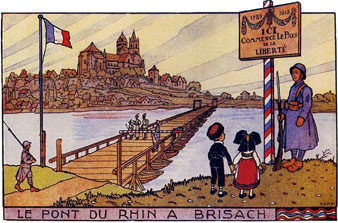
Figure 3


