I didn’t get my cha-cha heels! Divine Drag
Here’s a clip from the John Waters film that Butler references on p. 2541: FEMALE TROUBLE.
[youtube=http://www.youtube.com/watch?v=bpYTkavEt20&w=420&h=315]
Here’s a clip from the John Waters film that Butler references on p. 2541: FEMALE TROUBLE.
[youtube=http://www.youtube.com/watch?v=bpYTkavEt20&w=420&h=315]
When one thinks of fetishism, without researching or looking into the science of the concept, it is most probably simply an object, body part, or even an action that sparks an emotion of sexual release. The fetish object is often not one that we have chosen ourselves and can be one that is not easily obtained and so through a building of sexual tension, the release of this desire is the ultimate realization of what the fetish is. Today, the idea of a fetish is normative and differs from person to person. To me, a fetish can only be realized through the range of experiences, such that the one fills a void is the one we come to acknowledge as our fetish.
Psychoanalyst, Sigmund Freud, argued many theories about the development of the human sexuality explained at an unconscious level, which is troubling enough because there is no definitive way to measure the unconscious or the pathway through which the unconscious thought becomes a conscious action. The reading “Fetishism” was difficult to understand because of my inability to relate. Though his arguments deem sound because he observed or interviewed adult men, considering the imaginative nature his arguments, evidence for his track of thought is incomplete. I can agree that fetish stems from an event that affects the way we explore our sexuality, I cannot necessarily agree that it stems from the fear of castration because of its desirous nature. When Freud describes the initial experience of a young infant boy that realizes his mother’s parts are unlike his, I am still uncertain as to how that leads to the substitution of a body part or inanimate object that then becomes a fetish. This is because the ranges of fetishes are infinite and often cannot be described as an object that reminds one of their childhood and more often than not, people have multiple fetishes. I therefore argue that a fetish is desirous because it provides an emotion or sexual tension that we seek and cannot get elsewhere. In order to discover a fetish or multiple fetishes, exploration (and not “investigation”) is required.
On page 843, Freud states, “Why some people become homosexual as a consequence of that impression, while others fend it off by creating a fetish, and the great majority surmount it, we are not able to explain.” The idea that homosexuality is not predetermined and is too a result of the castration complex was just as troubling because aside from desiring the same sex, homosexuals can too have separate fetishes. The distinction the path by which the infant determines or chooses between fetishism and homosexuality wasn’t well explained or proven, as much as it may have seemed like a sequential outcome.
Also, in Freud’s introduction of fetishism, it was difficult to understand from a woman’s perspective simply because we have the same parts as our mother’s and do not experience the same fear. Since his observations consisted of male subjects, the weakest point of his argument comes from the difficulty to empathize with the castration complex is irrelevant because women do not go through the same process of the initial experience in which Freud describes as the point of fetish introduction. Is it then abnormal for a woman to have fetishes? Knowing that women do have fetishes, I began to question whether we too undergo a process by which a fetish becomes the substitute or if there is a deeper understanding to fetishism that Freud could not describe.
Lately, I’ve been looking at caricatures and sketches dating from the turn of the 20th century. They come from Alsace, which straddles the Rhine River, crammed between France and Germany. Since 1870, Alsace has been caught amid recurring wars between the two great nations of the time. Since 1870, Alsatians have switched nationalities five times, some willingly, others not so. I won’t begin to touch upon the burgeoning regionalism only nascent at the time of these caricatures for fear of writing a book. However, in light of their historical context and the explicit French sentiment they express, not to mention their publication and dissemination in France, these illustrations can be interpreted as propaganda. How is this helpful? Perceiving these illustrations as propaganda emphasizes their persuasive element that is dependent on their metaphorical construction. A Lacanian analysis will illustrate the intended effect upon the audience, in regards to whom little French children were to meant to identify with.
Before Lacan can be of any use, a postcolonial interpretation of the Other will first edify how the Other is depicted through the use of stereotype. If we are to assume, as Homi Babha has posited, that national identities are transitional and indeterminate, then a definite relation between the subject and the Other is impossible. Yet, that is patently false in artistic representations. Therein, stereotypes crystallize difference so as to define the Other in relation to the subject. In doing so, the Other is inculcated into a discourse in which it is knowable and thus definable. Here, Lacan illumines that knowledge of the Other is, and can only be, defined by knowledge of the subject, and, by consequence, vice versa. Stereotypes thereby act not only as typification of the Other, but as typification of the subject. Idyllic representations thus invest propaganda with power through their extension of discourse to include the Other. A reader would then be able to identity with a representation through a negative identification with the Other.
Examples will illustrate the connection I have established between children’s literature, propaganda, stereotypes, and Lacan. All three images (included below) are illustrations from Jean-Jacques Waltz (a.k.a. Hansi) in his book L’histoire d’Alsace racontee aux petits enfants (The history of Alsace told to little children) which was very popular in France and received semi-state recognition. Three elements are immediately recognizable: Germans, Alsatian (depicted as children), and Frenchmen. This work was meant to associate the region with French national sentiment so the German is the Other. However, the German is depicted in two drastically alternative ways. Figure 1 presents a family of Germans barred from Alsace (note the French tricolor post) that appear emaciated. Indeed, the caption reads that they are as “skinny as nails”. Yet, figure 2 depicts a healthy German soldier who resembles the French soldier in figure 3. A reader must account for these stereotypes in relation to the subject. Figure 1 presents no Alsatian or Frenchmen with which to contrasts the sickly Germans; however, the post presents a barrier between the reader and the image. A French child is presented a distinction between him- or herself and the Germans on the other side of the tricolor post. Figure 2 should take into account the relation between the imperial soldier and the Alsatian children that are oppressed by his gaze (another discussion would include the boy’s snide glare). Yet, a French child would not be able to identify with the Alsatian children in figure 2 were it not for figure 1 and the contrast of figure 3. This last representation is of a French soldier, facing the reader, and of Alsatian children facing the soldier. Whereas the children were meek under the German, they are proud with the French soldier. Indeed, the reader can only establish this relation because the children gaze up into the soldier who has a proud demeanor. Those Alsatian children thus perceive themselves in the reflection of the soldier’s gaze. Similarly, French children would identify nationally with the French soldier and, via him, the Alsatian children.

Figure 1

Figure 2
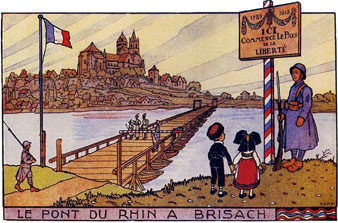
Figure 3
In his book, The Interpretation of Dreams, psychoanalyst Sigmund Freud describes a psychological condition of one having romantic and sexual desire for the parent of the opposite sex, while hating the other parent, as the “Oedipus complex”. This term is coined from Freud’s analysis of Sophocles’ play, Oedipus Rex, in which the titular character (by force of prophecy) unknowingly murders his father and weds his mother, as well as fathering children with her. Freud compares how this factor in Oedipus Rex compares to how it plays out in William Shakespeare’s Hamlet.
The difference in the manifestation of the Oedipus complex in the two plays is rooted in the differences between the two respective main characters. Oedipus is a character who is defined by his actions; he is unaware of fulfilling both the prophecy and his subconscious urges, which ultimately drives the tragedy of the play. Freud states, “Oedipus Rex is what is known as a tragedy of destiny. Its tragic effect is said to lie in the contrast between the supreme will of the gods and the vain attempts of mankind to escape the evil that threatens them. The lesson which, it is said, the deeply moved spectator should learn from the tragedy is submission to the divine will and realization of his own impotence,” (815). It is by Oedipus’s own actions – driven by both destiny and ignorance – that causes his ultimate downfall. This is where I disagree with Freud’s concept that he derives from this play; his theory entails that humans have this innate and subconscious desire for murdering one parent and performing coitus on the other, yet when that element of the psyche enters the conscious, the title character rejects it and punishes himself for it. My hypothesis is that had Oedipus had the knowledge of the identities of his mother and father, he would not have fulfilled the “prophecy” that was set for him. Freud doesn’t give human beings enough credit for self-control, let alone using a fictional character from a play to prove his theory.
With that said, I feel that Hamlet’s contrast in its titular character from Oedipus Rex further proves my thesis of Freud’s weakness in his Oedipus complex theory. Whereas Oedipus’s character is marked by his actions, Hamlet prevents himself from fulfilling the same prophecy. Freud states, “Hamlet represents the type of man whose power of direct action is paralysed by an excessive development of his intellect…According to another view, the dramatist has tried to portray a pathologically irresolute character which might be classified as neurasthenic,” (817). It is due to Hamlet’s ponderous and indecisive nature that he fails to act on his supposed desire. While Oedipus Rex is built on its title character blindly acting towards fulfilling the prophecy, Hamlet is built on its title character’s hesitations over killing the man that has essentially filled the role of his father. But Freud insists that it is the “peculiar” nature of this act that prevents Hamlet from commiting it, “Hamlet is able to do anything – except take vengeance on the man who did away with his father and took that father’s place with his mother, the man who shows him the repressed wishes of his own childhood realized,” (817-18). Thus, Hamlet sees in his father’s killer what psychology would dictate him to commit. Hamlet sees reproach in this act, which supersedes his desire for revenge. By witnessing his “repressed wishes” fulfilled by another entity, Hamlet gains a level of conscience that Oedipus never possesses until after he realizes who he killed, and who he wed.
Courtly love in the middle ages was what I would consider a crush today. The noble knight admired a woman, usually one who was married from afar and fantasized her. The woman is fantasized and the man has his own thoughts on what he thinks she is which is far from who she really is. As Slavoj Zizek says, “…how the Lady in courtly love has nothing to do with actual women, how she stands for the man’s narcissistic projection which involves the mortification of the flesh-and-blood woman…” Zizek shows here that courtly love has nothing to do with the actual woman and her feelings or morals. None of that. The man is pleasing himself with someone he’s imagined.
Courtly love reminds me very much of Lacan’s essay and the whole concept of the mirror image. Lacan’s concept of the mirror image is very relevant in today’s world and so is the whole courtly love idea. Courtly love is all about falling in love with an “image” and ideal image which as humans we do very much. Let’s think about all the women we admire on magazines and billboards. Their beauty is eye catching and it drives some to want that for themselves. The image in the mirror is very dangerous. We get caught up in it and we fantasize it. It drives us to being narcissistic and obsessive. We do the same when it comes to romanticizing relationships and marriage. Often times we look at other idea relationships and want that for ourselves too. This goes back to courtly love. In courtly love, the knight admires and romanticizes a love he doesn’t have and wants but can’t. We romanticize the ideal, admiring it for what seems perfect.
Zizek also makes a great point on page 2419 saying, “…he has attained what he really wanted: not the act itself, just her consent to it.” This goes back to the whole courtly love concept where the person fantasizes and has a greater love because he can’t have it but once he does, it’s not as expected. Why? Because the woman isn’t necessarily as similar as the man’s fantasies. Instead she is an actual human. I think this is what also annoys me when it comes to fantasizing women and romanticizing them in the media. They’re shown ideal and very unrealistic. This is also the same for the mirror image. The image we look up to is unrealistic, and we can never really attain that image at all. We just think we can and that’s what drives us. For example the young girls today who admire and look up to models and want to be like (appearance wise) but these girls don’t realize how unrealistic that image is that they’re looking up to. The models also are far from what they look in photos. In photos they are perceived as perfect but in real life they are flawed and they are human. Lacan’s work and Zizek’s work both are very relevant to today’s society and how we look at not just appearance but a lot of other things in life such as relationships and a big factor of it is social media. Social media helps us all out to look up to this mirror image and it also leads us to have this “courtly love” concept where we fall in “love” with someone based on what we see of them on social media.
According to Freud, in order for us to enjoy love, there need to be obstacles to attaining our objects of desire, and if there is a lack, we, ourselves, create such obstacles in order to obtain any deep psychical and physical pleasure from engaging in the act of love. Lacan improves upon this theory, as Zizek! notes, stating that the obstacles we create are there to conceal the impossibility of attaining our object of desire. The object of desire or the Lady in “courtly love” is, in fact, not an object at all, but a void upon which we project our desires and, thereby, which we transform from void into object through the expectations that this void-made-object could fulfill our desires if snared. We entirely forget, though, that it is we who have created the object which embodies the fulfillment of these desires and the obstacles to it, and arguably, that we have created the desires as well. Lacan argues that, without these self-constructed obstacles, one would be able to see the Lady for what she is, a “black hole.” However, our own hindrances, or, detours, supplant the void and both actualize and perpetuate the mirage that is the object of desire. In addition to creating the object, the detours then lead us to the elevation of the object into the das ding, the unattainable Real, which, in turn, actualizes desire. The fulfillment of desire is, after all, the end of desire. Thus, the Lady begins as an ‘unserviceable’ void, upon which we create an object, whose unattainability transforms the unserviceable void into a serviceable one. The void starts out as the source of nothing and becomes the source of desire. (is that it?) Zizek! makes the point that it is the end of this desire, which terrifies the lover deeply. Arguably, the knight fears the end of desire for the Lady because it means the end of his quest and his suffering, which dictates the nobility upon which his very identity relies. An immensely different kind of suffering, one of dying without death, would ensue, were the quest to end.
Moreover, can one still say that the Lady is a creature with whom one is unable to empathize as she is elevated into the realm of Lacanian’s Real and say that the Lady is not a spiritualization. In my opinion, one need not to empathize with one’s spiritual guide in order for the guide to properly carry out his or, in this case, her, or perhaps even more accurately, its role. A saint, one with superior spiritual knowledge or experience, is necessarily inhuman and distanced. The argument Zizek! provides to counter the Lady’s spiritualization is the “unspiritual” nature of the Lady’s demands such as licking her ‘arse’. “The Lady is thus as far as possible from any kind of purified spirituality” (2408). Even if this example does not reflect a purified spirituality on the part of the Lady, can one argue that she is an “automaton” as Zizek! does through this example. I would argue no because the knight’s fear is fecal odor and the possible urination upon his head from the Lady. The fact that the Lady can defecate places her in the realm of human and animal not somewhere beyond. These necessities do not identify the Lady as radically other, while they may eliminate a sense of her spiritual purification, but they are the foundation of an innate comradeship.
Something I noticed throughout the semester is that, like Saussure, theorists split their object of research and analysis into several parts. Sigmund Freud follows this way of analysis in his “Interpretation of Dreams” but there are some discrepancies. This chapter of his book gives us an insight to the psychoanalytic manner of interpreting dreams. Before talking about dreams, Freud introduces us to the idea of the unconscious by explains the Oedipus complex. Freud says, “It is the fate of all of us, perhaps, to direct our first sexual impulses towards our mother and our first hatred and first murderous wish against our father” (Freud 816). This statement give us an insight of what is the unconscious mind; the unconscious, the id, mind contains our deepest sexual desires, murderous wish and any kind of thought that is considered immoral and/or unrealistic . But these thoughts do not get to the conscious mind, and if they do then we have a case of psychoneurosis. With this said, let’s look at Freud’s analysis of dreams.
Freud split dreams into two elements. Freud states that in order to properly interpret dreams its necessary to analyze the latent content and manifest. The latent content contains the “dream-thoughts” which are the thoughts in the id inaccessible to the ego. On the other hand, the manifest content contains the “dream-content” which are the events or pictographic symbols that we tend to remember when we wake up. These are the two elements that compose a dream. According to Freud, the dream-content “seems like a transcript of the dream thoughts into another mode of expression…” (Freud 819). What it means is that the process of dreaming is about turning dream-thoughts into dream content.
At first glance, this relationship is similar to how Saussure splits language. Saussure describes language as a system of sign and split the sign in two parts. Likewise, Freud split dreams. Saussure splits the sign into the signified and the signifier. The signifier is what we use to express the concept or signified. Similarly, the manifest contest expresses what is present in the latent content. Both theorist go into a deep explanation on how this relation works. However, this similarity does not get any further.
There are discrepancies between these theories. Saussure describes the relation between the signifier and signified as arbitrary. In addition, language, in Saussure’s perspective, is linear; it is a simple and direct connection easy to understand because language is a natural tool we use to survive. On the other hand, Freud’s interpretation of dreams states that the relation between the latent content and manifest content is transitional. That is to say, the former is the translation of the latter (Freud 818-9). Additionally, the relation between the latent content and manifest content is quite complex due to several reasons: One, the unconscious or id do not speak the same language we consciously do. Therefore, accurate translation and interpretation of the dream is extremely difficult, if not impossible. Moreover, the dream-content can have a meaning of its own or not make sense at all despite being one side of a coin. We have to analyze it deep and critically enough to grasp an idea of what is the dream-thought is.
We have to go through many layers to achieve complete understanding. We have to consider what Freud called “condensation.” Freud says, “Dreams are brief, meagre and laconic in comparison with the rage and wealth of the dream-thoughts” (Freud 819). It means that manifest content only contains a piece or a condensed version of the dream-thought from which we have to decipher the deeper meaning. We also have to consider that the dream-thoughts are “censored” when transfer to the ego or conscious because it is information that would affect us psychologically (Freud 820). To sum up Freud’s theory about dream interpretation have some similarities with Saussure’s Theory of language but they have a lot of differences.
According to Freud “I announce that the fetish is a substitute for the penis, I shall create disappointment; so i hasten to add that it is not a substitute for any chance penis.” (Freud 842) He then goes on to say the people with fetishes are substituting the mother’s imaginary penis. When we first discover that our parents have different sexual organs that we refuse to believe that our mother had a penis that had been castrated because as men we would feel in danger of losing our own. He relates this to our own narcissism and how we repress the fact that our mothers do not have a penis and use the fetish as a substitute. In class we were asked about our own fetish and no one wanted to share for what I presume to be fear of judgment, but nevertheless I will share mine. I like big butts and I cannot lie. There I have said it now lets move on to how Freud would analysis me. If I were to sit on a couch and tell Freud about my fetish he might come to his conclusion that at a point during my youth I noticed my mother did not have a penis when she bent over or some weird thing like that. But this theory could not be more wrong. First and foremost both genders are able to have fetishes and this limits fetishism to only males. Second in my personal experience fetishism does not have to substitute for any kind of penis whether it be a mother imaginary penis because it does not fit to the growth of the human mind. What I mean is at a young age I would not have a memory of not seeing my mother not having a penis and repress it until the age where we start having sexual interest and have it manifest. I would think that the manifestation of a fetish would spark around the time of sexual identity.
Another reason why Freud’s thoughts on fetishism does not work is in the read we had for Zizek. Zizek talks about the movie “The Crying Game” where the character Fergus is told to visit a captured British soldier’s girlfriend Dil. Fergus falls in love with Dil and purses her. After finally accepting his pursing of her Dil gives in and when they are about to have relations it is revealed that Dil is a transvestite as we call it now transsexual. Fergus confused and put off in this moment. Also in this moment Zizek says “This scene of the failed sexual encounter is structured as the exact inversion of the scene referred to by Freud as the primordial trauma of fetishism: the child gaze, sliding down the naked female body towards the sexual organ, is shocked to find nothing where one to expect to see something (a penis) in the case of “The Crying Game”, the shock is caused when the eye finds something where it expected nothing.” (Zizek 2421) This moment is ironic because the repression is no longer repressed. In fact there is “mom’s penis” but it does not bring satisfaction for Fergus. It does not satisfy his sexual needs for the repression to manifest therefore fetishism in Freud’s eyes does not work. Speaking as a heterosexual male I do not see how in fact I would be worried about castration when I noticed my parents have different sexual organs. Could it just be that boys are boy and girls are girls? What I mean is when we categorize people as children we can say mommy is a girl because she does not have a penis and daddy is a boy because he does have one. Instead Freud makes it seem like men with a fetish is trying to substitute for what the mother does not have and that just is not the case.
Blog #2 linguistics
Language-the concept of a sound created from the movement of the lips and tongue. Yet still without doing so one is able to recite a mental verse with the sound images on our head. The concept of the “phoneme” which is the sound of the word determined by vocal activity is eliminated from the Saussure’s views on language and the mind. The concept in translated into a sound image by the carrier we associate with the concept as an individual. We settle on the vocal activity to express this concept because we know no better option.
The arbitrary sign-within every society there is a set based of expressions, which are based on principal.
The function of language regarding thought is to create the precise and individual phonic sound in the expression of idea to link thought and sound.
The division between “thought-sound” is shapeless and implies division; Saussure compares the process to air pressure, water and atmospheric change, which turn into waves. When its windy the waves are larger and the opposite when not. The signified (wave) is more or less depending on the link (carrier), which represents the scale of the wave in this case (sound-image). The only reason the water has big waves or small waves are because it only knows to react or be so from the carrier to the concept or signified to signifier.
The way language and money relate is they both can be exchanged and compared. Exchanged for something of dissimilar value, which is to be, determined i.e. a piece of bread. It is compared to something similar in the exchange from a pound or dollars, which may slightly vary in exact value, put, serve same concrete purpose.
Saussure’s comparison to Greek architecture in defining the difference between “syntagmatic” and “associative” relations in style to words in groups which tie together, linking to part of a whole and at the same time remaining individual.
The individuality in speech in how one combines the words from these various groups together. The freedom of combination results that all synthases are not equally free.
Blog 5
The Cost Disease: Started From The Bottom Now…
The high arts and the individual’s reality of earning a living in a capitalist society follow two general realities according to Ross. One, the individual who holds the skills necessary to obtain intellectual professions such as professors, writers, painters etc. spends as much time, if not more obtaining the qualifications in order to hold these positions, yet receive much less capital gain than the, “others” for the honor they feel they receive in working in the profession they do. They feel it is an honor and privilege to be qualified enough to hold such a position of prestige that to place a monetary value on it is beneath them. In addition the cost of the performance has risen with the heightened technology-of actors per say which leave these intellectuals having to learn and develop more and more to keep up with the desires of the audience-special effects on Broadway. The amount of money to produce such a spectacle is much higher and the person who is affected by the increase in the price in the production is the amount the artist is paid. We all see how well that worked out for the actor who played Spiderman-who was actually harmed quite badly during a live performance. All due to the audience demands of artificial excitement in the art of story telling. Do the special effects make the performance any better? Is it impossible to imagine a flying spider man, rather than see the actor, we know cannot fly and shot cobwebs from his finger tips, pretend to do so with these “special” effects.
Who is to blame for the artists willingness to provide services in which they worked hard toward mastering, yet receive unfair compensation for the services they provide?
The response from the public is enhanced when there is mystery behind the artist’s work, especially if there is a public message and agenda behind the master’s skill. A perfect example of this is Banksy-a graffiti artist whose career and prestige is based soley on his ability to remain concealed. If we knew who he was and that he was capitalizing off of his very controversial and sometimes even illegal public displays-would we believe it? Would we care? Or would it just be some more spray paint vandalism?
I found the very last tid bit on the black artist and the demands of being paid in full to be interesting. The already suppressed nature of the black culture in turn generated an artist who demanded to be “paid in full”. The concept of being, “all about the Benjamin’s” in comparison to the white bohemian was not looked down upon. The “starving artist” is celebrated and recognized in the white community as heroic. Contrary, to the already suppressed history of the black community, talking about money and material gain is celebrated and remains a lyrical trend- in the hip hop community.
